How Confirmation Bias Affects What We Believe (and Why It Matters More Than Ever)
Confirmation bias causes us to seek, trust, and remember information that supports our existing beliefs while ignoring conflicting evidence. Learn how this cognitive bias shapes decisions, social media feeds, and everyday thinking, and discover practical ways to overcome it.
How Confirmation Bias Affects What We Believe
Every day, we make hundreds of decisions based on the information we consume. We scroll through social media, read news articles, watch videos, ask AI assistants questions, and discuss ideas with friends. Most of us assume we're evaluating information objectively.
But our brains don't always work that way.
One of the most powerful cognitive biases shaping our opinions is confirmation bias. It quietly influences which information we trust, which evidence we ignore, and ultimately what we believe to be true.
Understanding confirmation bias is one of the most important steps toward becoming a better critical thinker, especially in an era where information travels faster than ever before.
What Is Confirmation Bias?
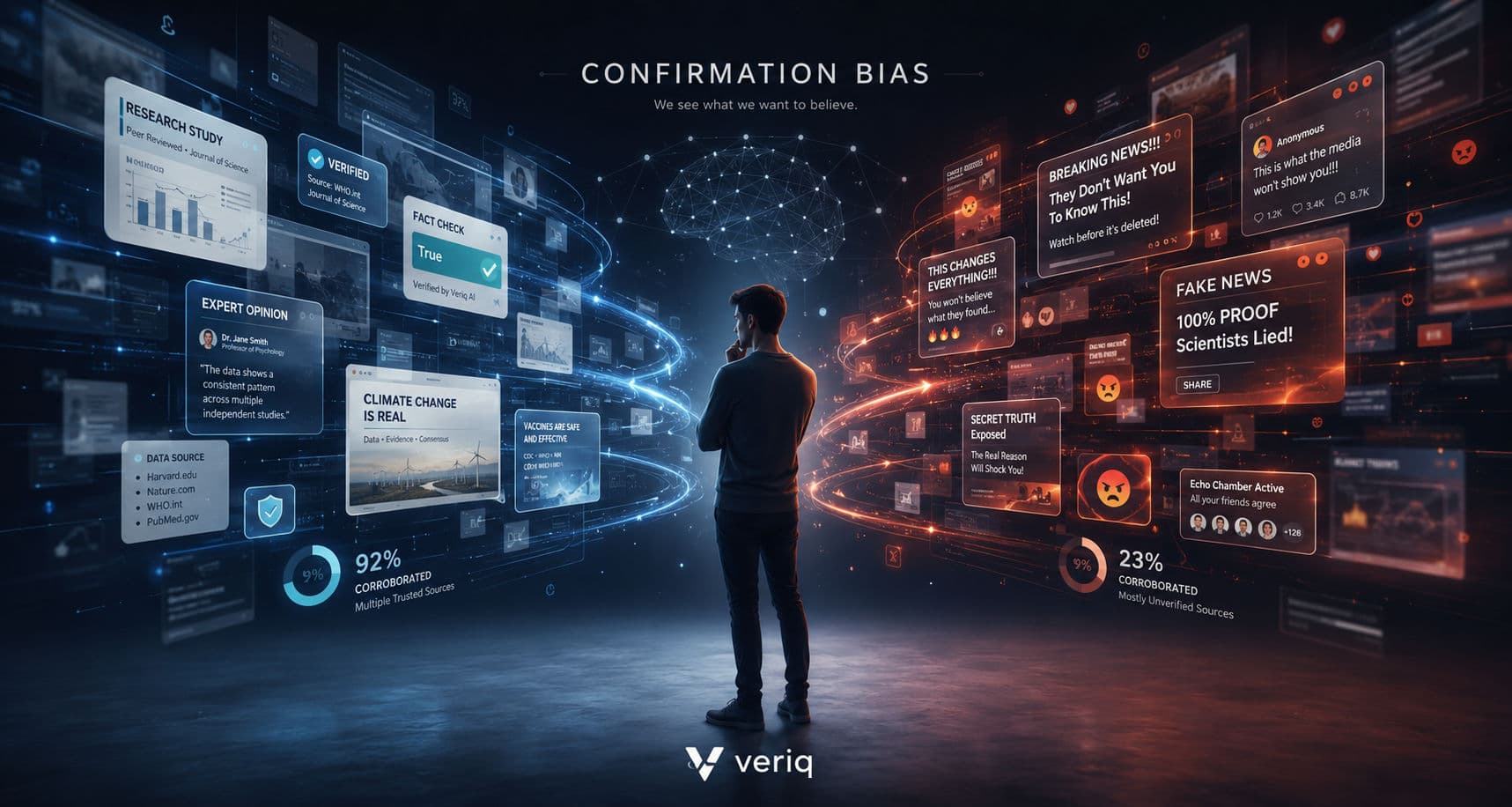
Confirmation bias is the psychological tendency to search for, interpret, remember, and favor information that supports our existing beliefs while dismissing or minimizing evidence that contradicts them.
Instead of asking:
"What does the evidence actually show?"
our minds often ask:
"How does this support what I already think?"
This happens automatically and affects everyone, regardless of intelligence, education, or experience.
A Simple Example
Imagine two people with different opinions about electric cars.
- One believes electric vehicles are the future.
- The other believes they're impractical.
When a news article reports improvements in battery technology:
- The first person shares it immediately as proof they were right.
- The second ignores it or looks for reports about charging problems.
Both individuals are exposed to information.
Only one type of information gets accepted.
That's confirmation bias in action.
Why Does Confirmation Bias Exist?
Our brains evolved to process information efficiently, not perfectly.
Changing deeply held beliefs requires mental effort and creates psychological discomfort.
Confirmation bias helps our minds by:
- Reducing uncertainty
- Preserving existing beliefs
- Making decisions faster
- Reinforcing our identity and worldview
While useful for quick decisions, this shortcut can lead to poor reasoning and misinformation.
Where Confirmation Bias Appears
Social Media
Recommendation algorithms often show content similar to what users have previously liked or interacted with.
Over time, this creates echo chambers, where people mostly encounter opinions they already agree with.
As a result, opposing viewpoints become rare, making personal beliefs feel universally accepted.
News Consumption
People often choose news sources that align with their political, cultural, or personal perspectives.
When multiple outlets report the same event differently, readers naturally gravitate toward the version that confirms their expectations.
AI Assistants
Modern AI systems generate responses based on prompts.
If users ask leading questions such as:
"Why is this conspiracy true?"
instead of
"What evidence exists for and against this claim?"
they may unintentionally receive responses that reinforce their assumptions.
Responsible AI encourages balanced questioning and evidence-based reasoning.
Online Reviews
Imagine someone convinced a product is excellent.
They'll likely notice positive reviews while dismissing negative ones as exceptions.
Someone expecting poor quality often does the exact opposite.
The Science Behind Confirmation Bias
Psychologists have studied confirmation bias for decades.
Research shows that people tend to:
- Seek evidence supporting existing beliefs.
- Interpret ambiguous information in their favor.
- Remember confirming evidence more easily.
- Forget contradictory information over time.
These patterns occur even when people sincerely believe they're being objective.
The Connection Between Confirmation Bias and Misinformation
False information spreads quickly when it matches what people already believe.
Instead of verifying facts, many individuals share content because it feels believable.
This creates a cycle:
- Existing belief
- Supporting content appears
- Content gets shared
- More people encounter it
- Belief becomes stronger
The result is misinformation spreading faster than carefully verified facts.
Confirmation Bias in the AI Era
Artificial intelligence has transformed how information is created and consumed.
AI can generate:
- Articles
- Images
- Videos
- Voice recordings
- Social media posts
While these tools are incredibly useful, they also make it easier for misleading content to appear convincing.
When confirmation bias combines with AI-generated misinformation, distinguishing fact from fiction becomes increasingly difficult.
That's why verification matters more than ever.
How to Reduce Confirmation Bias
No one can eliminate confirmation bias completely, but everyone can reduce its influence.
1. Look for Opposing Evidence
Instead of asking:
"Why am I right?"
ask:
"What evidence would prove me wrong?"
This simple habit dramatically improves critical thinking.
2. Verify Multiple Sources
Don't rely on a single headline or viral post.
Compare information across reputable sources before drawing conclusions.
3. Separate Facts from Opinions
Facts can usually be verified.
Opinions reflect interpretations.
Learning to distinguish between the two helps avoid emotional reasoning.
4. Slow Down Before Sharing
Emotional content spreads rapidly because it triggers immediate reactions.
Take a moment to verify information before reposting or forwarding it.
5. Stay Curious
Approach new information with curiosity rather than certainty.
The goal isn't always to prove yourself right.
It's to get closer to the truth.
Why Fact-Checking Matters
Independent fact-checking helps counter confirmation bias by evaluating claims using verifiable evidence instead of personal opinions.
Modern AI-powered verification tools can:
- Compare claims against trusted sources
- Detect misleading narratives
- Identify manipulated media
- Provide evidence-backed explanations
Technology cannot eliminate bias entirely, but it can encourage more informed decision-making when combined with critical thinking.
Final Thoughts
Confirmation bias is part of being human.
It influences everyone, regardless of education or expertise.
The challenge isn't to eliminate bias entirely, but to recognize when it's shaping our decisions.
In a world filled with social media feeds, AI-generated content, viral videos, and endless information, the most valuable skill isn't finding more information.
It's learning how to evaluate it objectively.
The next time a headline perfectly matches what you already believe, pause for a moment.
Ask yourself:
"Do I believe this because it's true—or because I wanted it to be true?"
That single question may be the first step toward better critical thinking.