The Future of AI in Fact Checking: How Intelligent Verification Will Transform Digital Trust
Artificial intelligence is reshaping how misinformation is detected, verified, and explained. Discover how AI-powered fact checking will evolve over the next decade and why human oversight remains essential.
The Future of AI in Fact Checking
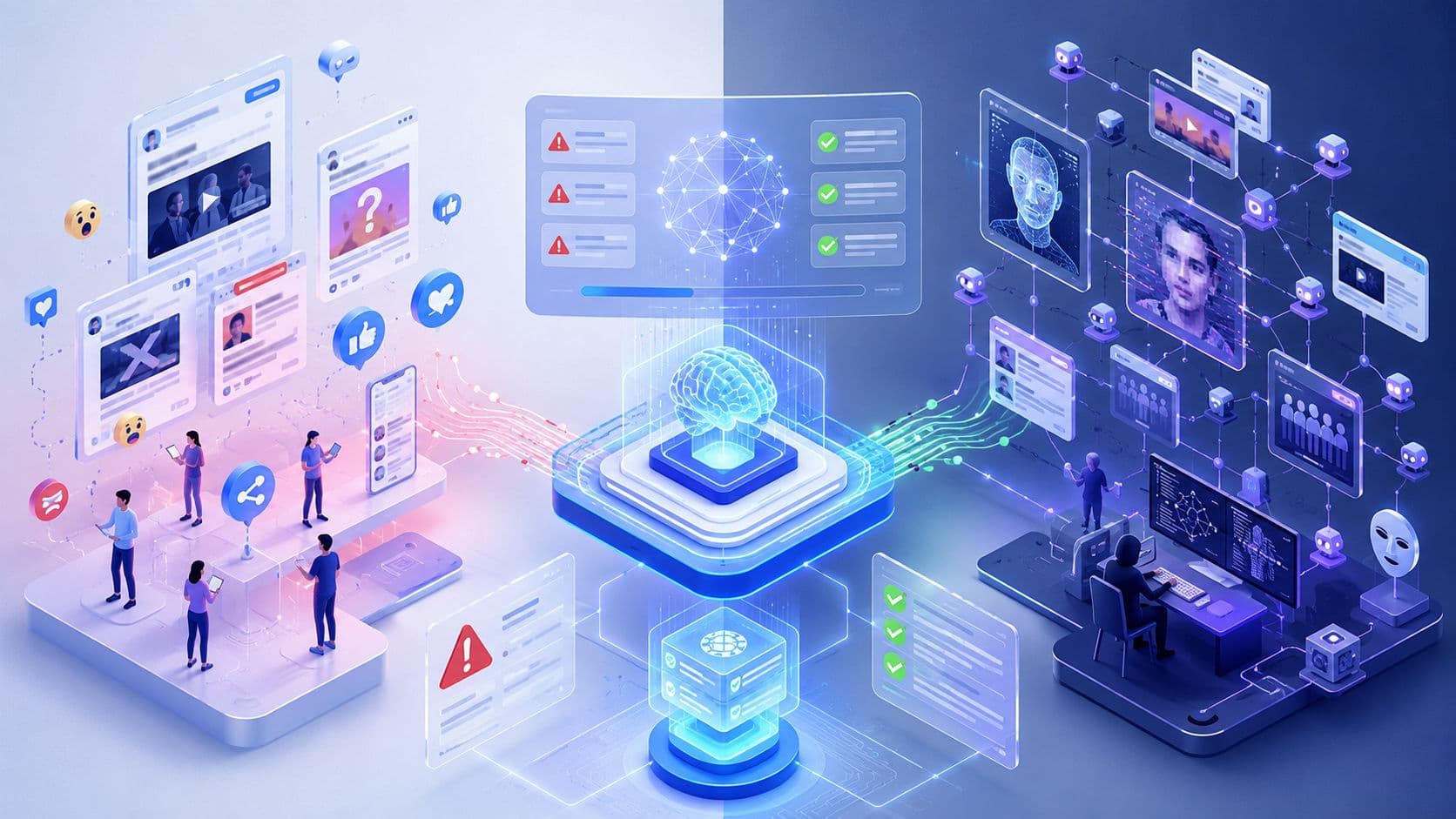
Every minute, millions of posts, videos, articles, and comments are published across the internet. While this unprecedented flow of information has made knowledge more accessible than ever, it has also made misinformation faster, cheaper, and more convincing.
Traditional fact-checking organizations play a critical role, but manual verification simply cannot keep pace with the scale of today's digital world.
This is where artificial intelligence is beginning to change the landscape.
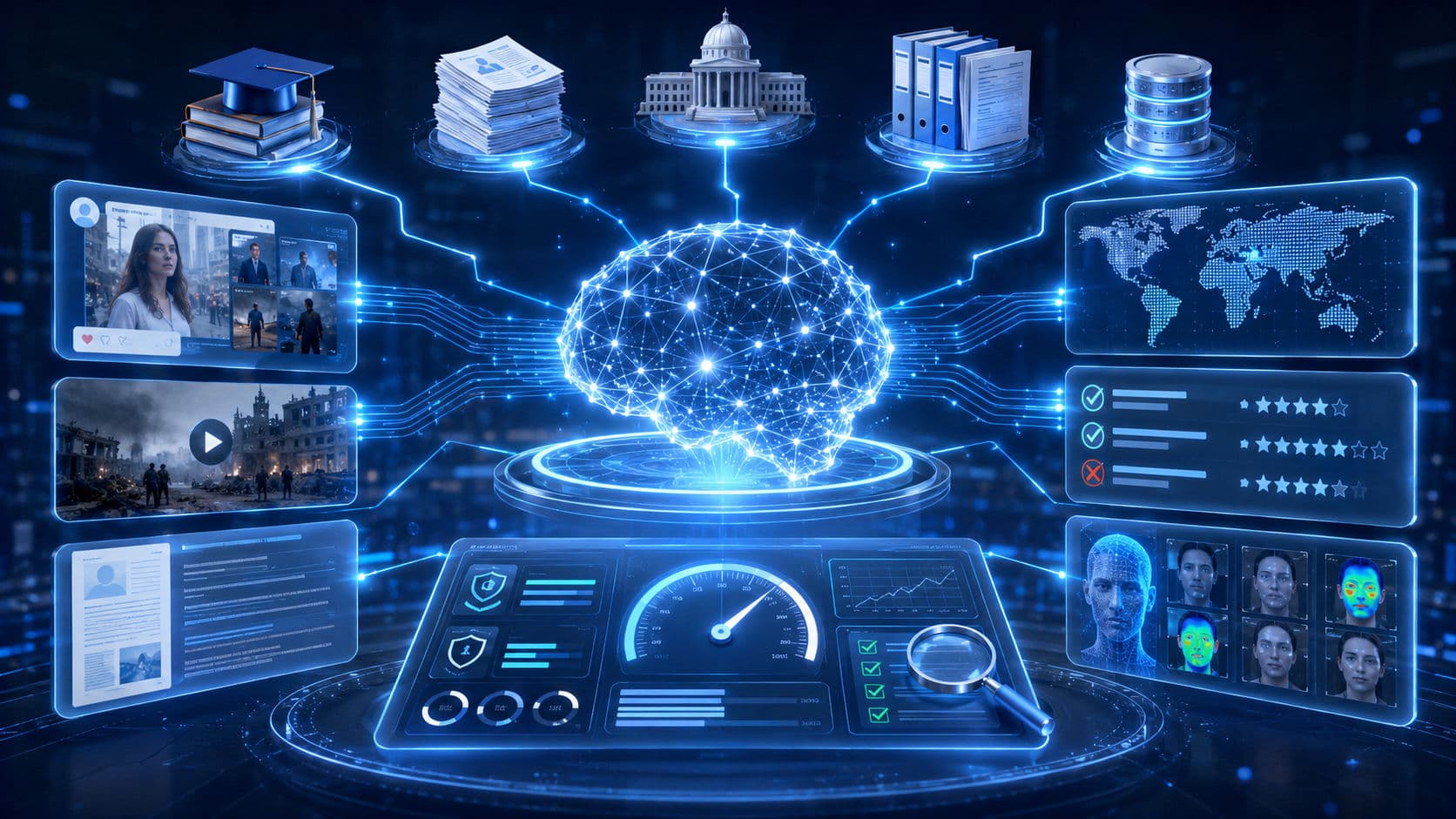
AI is no longer just a tool for generating content. It is rapidly becoming one of the most powerful technologies for verifying it. Over the next decade, AI-powered fact checking will evolve from a helpful assistant into an intelligent verification layer that helps people make informed decisions in real time.
Why Traditional Fact Checking Isn't Enough
Conventional fact checking follows a structured workflow:
- A claim gains attention.
- Researchers gather evidence.
- Trusted sources are reviewed.
- Experts analyze the claim.
- A report is published.
While this approach produces highly reliable results, it often takes hours or even days.
Unfortunately, misinformation spreads much faster than corrections.
By the time an article is published debunking a viral post, millions of people may have already shared or believed it.
The future requires verification that happens within seconds, not days.
How AI Is Changing Fact Checking
Modern AI systems can already perform several tasks that previously required significant manual effort.
These include:
- Speech-to-text transcription from videos
- Detection of factual claims within conversations
- Information retrieval from trusted sources
- Cross-language translation
- Evidence summarization
- Confidence estimation
- Citation generation
Instead of replacing fact-checkers, AI dramatically accelerates the research process by narrowing thousands of possible sources into a small set of highly relevant evidence.
This allows human reviewers to focus on judgment rather than data collection.
From Keyword Search to Semantic Understanding
Earlier verification systems relied heavily on keyword matching.
Modern AI understands meaning.
For example, these statements communicate the same idea:
- "Coffee reduces heart disease."
- "Drinking coffee lowers cardiovascular risk."
- "Regular coffee consumption benefits heart health."
A semantic AI system recognizes these as variations of the same claim, even though the wording differs significantly.
This capability allows future fact-checking systems to retrieve stronger evidence and identify misleading paraphrases more accurately.
Real-Time Verification
Imagine watching a video online.
Instead of leaving the app to search for evidence, an AI assistant could automatically:
- Detect factual claims as they are spoken.
- Search trusted sources instantly.
- Compare conflicting information.
- Explain the available evidence.
- Present confidence scores.
- Highlight uncertainty when evidence is inconclusive.
Verification becomes part of the viewing experience rather than a separate research task.
This shift has the potential to dramatically reduce the spread of misleading information.
Multilingual Fact Checking
Much of today's misinformation spreads in regional languages long before it reaches mainstream media.
Future AI systems will support verification across dozens of languages by combining:
- Automatic language detection
- High-quality translation
- Cross-language evidence retrieval
- Local news indexing
- Regional government databases
This makes reliable verification accessible to significantly more people worldwide.
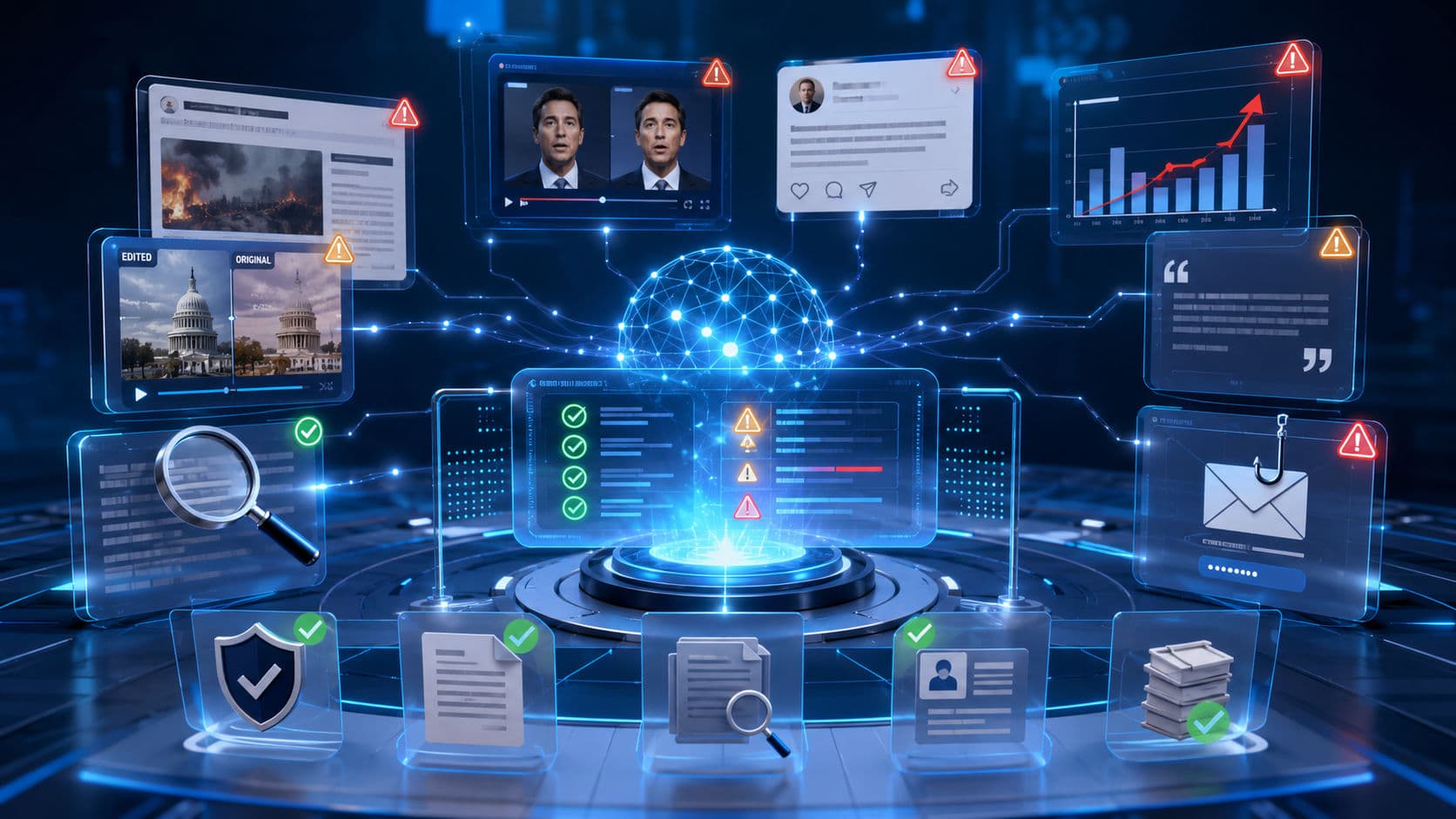
Fighting Deepfakes and Synthetic Media
Generative AI has made realistic fake content easier to create than ever before.
Future verification systems will need to analyze much more than text.
They will examine:
- Audio authenticity
- Image manipulation
- Video inconsistencies
- Metadata integrity
- Editing artifacts
- AI generation fingerprints
Rather than asking only "Is this statement true?", future AI will also ask:
"Was this media created or manipulated artificially?"
Combining media forensics with factual verification will become increasingly important.
The Role of Large Language Models
Large Language Models (LLMs) are transforming how evidence is analyzed.
Instead of simply returning search results, modern AI can:
- Explain why evidence supports or contradicts a claim.
- Compare multiple sources.
- Identify conflicting viewpoints.
- Summarize long research papers.
- Generate understandable explanations for non-experts.
However, LLMs are not perfect.
They can occasionally generate incorrect information if not grounded in reliable evidence.
For this reason, future systems will increasingly rely on Retrieval-Augmented Generation (RAG), where AI retrieves trusted documents before generating an answer.
Evidence-first reasoning is becoming the new standard.
Human Oversight Will Always Matter
Despite rapid advances, AI should not become the final authority on truth.
Many claims involve:
- Political interpretation
- Scientific uncertainty
- Emerging events
- Legal nuance
- Context-dependent statements
These situations require human judgment.
The strongest future systems will combine:
- AI for speed
- Humans for accountability
- Transparent evidence for trust
Verification should remain explainable rather than opaque.
Privacy-First Fact Checking
As AI becomes more deeply integrated into everyday browsing, privacy will become increasingly important.
Future platforms should minimize unnecessary data collection by:
- Processing information locally when possible
- Uploading only essential content
- Encrypting temporary data
- Deleting uploaded files after verification
- Providing transparent data policies
Users should be able to verify information without sacrificing personal privacy.
Challenges That Still Need Solving
Several technical and societal challenges remain.
Hallucinations
AI models sometimes generate confident but incorrect responses.
Grounding answers in trusted sources is essential.
Source Reliability
Not every website deserves equal trust.
Future systems must continuously evaluate source credibility rather than treating all information equally.
Bias
Training data, search engines, and source selection can introduce bias.
Transparency about evidence selection will be critical.
Speed vs Accuracy
Users expect instant results, but rushed verification can produce mistakes.
Balancing responsiveness with reliability remains an ongoing challenge.
What the Next Decade Could Look Like
Within the next ten years, AI-powered fact checking may become a standard feature across digital platforms.
Instead of relying on separate websites, verification could be built directly into:
- Social media platforms
- Video streaming apps
- Search engines
- Messaging applications
- News readers
- Web browsers
As misinformation becomes more sophisticated, verification tools must become equally intelligent.
The future is not about replacing critical thinking with AI.
It is about giving people faster access to credible evidence so they can make informed decisions for themselves.
Conclusion
The future of fact checking lies in collaboration between artificial intelligence and human expertise.
AI offers unmatched speed, scalability, and multilingual understanding, while human reviewers provide judgment, accountability, and context that machines cannot fully replicate.
The goal is not to create an AI that decides what people should believe.
The goal is to build systems that help everyone evaluate information using transparent evidence, reliable sources, and clear explanations.
As the internet continues to evolve, trustworthy verification will become one of the most valuable technologies of the digital age.
At Veriq, we believe the future of fact checking is not simply faster—it is smarter, more transparent, privacy-conscious, and accessible to everyone.